A real estate website converts visitors into qualified leads when it makes the next step obvious and easy for every type of visitor. That takes four things working together: fast, accurate IDX property search; clear calls-to-action and lead capture forms on every page; trust signals such as testimonials, credentials, and recent sales; and hyperlocal content that proves you know the market. Strong design, fast load times, and a true mobile-first experience tie it all together.
Most agents’ websites get traffic. Buyers and sellers browse the listings, click through a few pages, and leave without reaching out. Then they call the agent whose website made contacting them easy.
In 2026, your website is your most important marketing asset: a 24/7 salesperson, credibility builder, and lead generation engine. For most prospects it is the first impression of your business, and it often decides whether they contact you or a competitor.
The X Concept has built real estate websites since 2006. As a Showcase IDX Certified Partner, we have designed sites for agents and brokers at Compass, Coldwell Banker, ERA, JB Goodwin, Big Block Realty, and more. This guide explains what separates real estate websites that generate leads from those that don’t.
What does it mean to convert website visitors into leads?
Converting visitors into leads means turning anonymous people who browse your real estate website into identified prospects who share their contact information and ask for your help. A qualified lead is a visitor with real buying or selling intent, such as someone requesting a showing, a home valuation, or a listing consultation.
The conversion rate is the share of visitors who take that step. Every design decision on a real estate website should raise it.
Why are real estate websites harder to convert than other websites?
Real estate websites serve several audiences at once, handle live MLS data, and ask visitors to trust you with a six- or seven-figure decision. Generic website templates are not built for any of that.
Who visits a real estate website, and what does each visitor want?
- Buyers browsing available properties
- Sellers evaluating agents to list their home
- Investors researching market opportunities
- Neighbors checking local home values
- Past clients returning for market updates
Each group needs different content and a different path to contact you. A one-size-fits-all site serves none of them well.
What property search features do home buyers expect?
- MLS integration with current, accurate listings
- Advanced filters for price, location, and features
- Map-based search
- Saved searches and email alerts
- Favorites and comparison tools
- A smooth mobile search experience
Poorly implemented search frustrates users, and they leave for sites that work better.
How does a real estate website build trust with prospects?
Buying or selling a home is a high-stakes, emotional decision. Your website builds trust through:
- Professional design that signals competence
- Agent credentials and experience
- Client testimonials and success stories
- Visible market and neighborhood expertise
- Signs that you respond quickly
Why does mobile matter so much in real estate?
Buyers search while driving through neighborhoods. Sellers research agents on their phones. Clients review homes during commutes and after hours. If your site isn’t excellent on mobile, a large share of prospects never sees you at your best.
Why does hyperlocal expertise affect conversions?
Successful agents specialize geographically, and their websites prove it with:
- Neighborhood pages
- Local market statistics and trends
- Community information and resources
- School district details
- Local business and amenity guides
This content positions you as the local expert and captures location-based search traffic.
What stops a real estate website from generating leads?
Most real estate websites lose leads to the same seven problems.
Is your navigation confusing?
Within seconds, visitors should know how to search properties, learn about you, contact you, and see what makes you different. Unclear menus and buried contact details send them away.
Is your property search too slow?
Visitors have no patience for slow, clunky search. Slow-loading results, confusing filters, or inaccurate listings make people leave immediately.
Are your calls-to-action missing or weak?
Common mistakes include:
- No obvious way to contact the agent
- Messaging that doesn’t motivate action
- Too many options, causing decision paralysis
- Forms buried on a contact page few visitors reach
Every page needs a clear call-to-action that guides visitors to the next step.
Does your site look like a generic template?
Consumers spot templates instantly. A site that looks like hundreds of others signals low investment, little attention to detail, and generic service. Custom design that reflects your value proposition sets you apart.
Is your mobile experience frustrating?
Over 60% of real estate searches happen on mobile devices. These issues kill mobile conversions:
- Property photos too small to evaluate
- Search filters hard to use on a phone
- Text that requires zooming
- Buttons too small to tap
- Slow mobile load times
Is your content outdated?
No recent blog posts or market updates, sold homes still listed, years-old testimonials, and stale neighborhood pages all suggest an inactive agent. Few people hire an agent whose website looks idle.
Are trust signals missing?
Without professional photography, testimonials, credentials, awards, community involvement, and easy ways to reach you, your website can’t earn the trust a real estate decision requires.
Which design elements turn real estate website visitors into leads?
High-converting real estate websites share seven elements.
How does IDX integration affect lead generation?
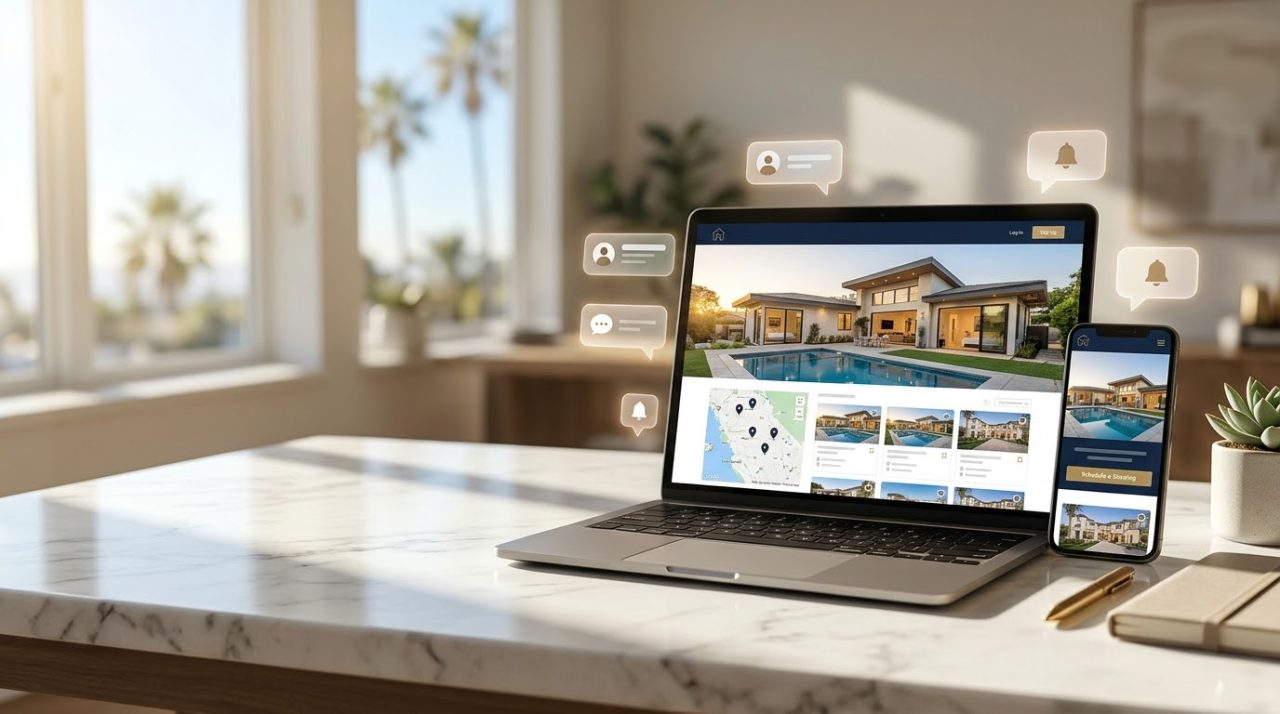
IDX (Internet Data Exchange) displays MLS listings on your website, but implementation quality varies widely.
| Poor IDX implementation | Professional IDX implementation |
|---|---|
| Slow property search | Fast property search |
| Limited filters | Comprehensive filtering and sorting |
| Broken on mobile | Fully optimized for mobile |
| Inaccurate or outdated listings | Accurate, real-time MLS data |
| Unattractive property displays | Polished property displays, map search, saved searches, email alerts, and built-in lead capture |
The gap between the two is the gap between frustrating visitors and converting them.
Where should a real estate website capture leads?
Capture leads at every stage of the buyer and seller journey:
- Early stage: newsletter signup, saved search alerts, home value estimates, neighborhood guides
- Mid stage: showing requests, property inquiries, mortgage calculators, comparative market analysis requests
- Late stage: consultation scheduling, listing presentation requests, direct contact
Each capture point needs a compelling offer and a short, friction-free form. Most sites offer only a basic contact form and miss the rest.
How should agent branding answer “Why you?”
Your website must explain why someone should hire you over any other agent. Effective branding includes a clear value proposition, professional photos and video, a full bio, your specializations, performance statistics, testimonials and case studies, community ties, and some personality. Generic bios and stock photos don’t win comparison shoppers.
What local content proves market expertise?
- Neighborhood pages: demographics, schools, amenities, market trends, lifestyle, transportation, and dining
- School information: district details for parents, who often choose homes by school
- Market updates: regular statistics and trend analysis
- Community guides: events, businesses, services, and attractions
This content takes real investment, which is why most agents skip it and why those who do it capture a disproportionate share of leads.
What does a mobile-optimized real estate website include?
- Fast loading on cellular connections
- Touch-friendly buttons and links
- Simplified navigation
- Property search designed for small screens
- One-tap click-to-call
- GPS-based nearby property search
Many sites are technically “responsive” but not truly built for mobile users.
Which trust signals increase conversions?
- Video testimonials, which outperform written reviews
- Recent transactions that show active success
- Awards and industry recognition
- Press mentions and interviews
- Active social media integration
- Professional associations and certifications
How does property presentation win listings?
Sellers judge how you would market their home by how you market others. Strong presentation includes professional photography, 3D tours and video walkthroughs, lifestyle-focused descriptions, neighborhood context, and map integration with nearby amenities.
What technical foundation does a lead-generating real estate website need?
Behind the design, five technical areas decide whether the site performs.
What makes IDX and MLS integration complex?
It involves choosing the right IDX provider, configuring data feeds, keeping thousands of listings fast, ensuring mobile responsiveness, connecting lead capture, managing SEO, and staying compliant. Get any of these wrong and property search becomes slow or broken.
How do you keep a listing-heavy website fast?
Large photo galleries, dynamic search results, maps, video, and filtering queries all slow a site down. Keeping load times fast with this much rich content requires specialized expertise.
How should the website connect to your CRM?
Your site should send every lead straight into your CRM, with automatic capture, instant notifications and routing, follow-up automation, lead source tracking, and property inquiry tracking. Without it, leads wait in an inbox and follow-up slips.
What is different about SEO for real estate websites?
Real estate SEO means optimizing thousands of property pages, handling duplicate content from similar listings, ranking for hyperlocal keywords, building location landing pages, and competing with portals like Zillow and Realtor.com. Generic SEO doesn’t solve these problems.
What security and compliance rules apply?
Your site must protect lead data in transit, respect consumer privacy laws, follow MLS data rules, comply with fair housing requirements in all content, and meet accessibility standards. Missing any of these creates legal risk and erodes trust.
Why do DIY and template real estate websites fail to generate leads?
DIY sites usually look acceptable but convert poorly, for five reasons.
- Template limits: generic designs, little customization, weak IDX options, poor mobile optimization, minimal SEO, and no lead capture strategy.
- Technical complexity: IDX, forms, CRM integration, advanced search, and performance tuning require skills most agents don’t have.
- Time cost: custom layouts, neighborhood content, SEO for hundreds of pages, imagery, and testing add up to hundreds of hours. Many DIY projects never get finished.
- No strategy: without mapped user journeys, defined personas, and planned funnels, a site may look decent and still produce no leads.
- Maintenance burden: IDX feed monitoring, content updates, security patches, performance checks, and form testing never stop.
What does professional real estate web design deliver?
A specialist builds the site around conversions, not just appearance.
- Strategy: market and competitor analysis, a clear value proposition, defined client personas, and a conversion funnel for each audience
- Custom design: unique layouts, a cohesive visual identity, mobile-first pages, and conversion-focused structure
- Technical implementation: fast IDX, CRM-connected lead capture, real estate SEO, and security and compliance
- Content: agent bios, neighborhood pages, market updates, an initial blog strategy, and SEO-optimized copy
- Ongoing optimization: monitoring, maintenance, content updates, conversion testing, and new features as your business grows
What ROI can agents expect from a professional real estate website?
One extra closed deal can pay for the whole website. Here is how the math works.
Lead value: Suppose a professional site generates 2 to 3 more qualified leads per month than a DIY site. At a 30% close rate and an $8,000 average commission, that is $5,000 to $7,500 in added monthly revenue, or $60,000 to $90,000 a year, against a one-time investment of $5,000 to $10,000.
Time recovered: If a DIY site takes 200 hours a year to build and maintain, and your time is worth $100 an hour, that is $20,000 a year you could spend prospecting, showing homes, and negotiating.
Competitive positioning: When competitors have professional sites, a DIY site makes you look less established, and prospects contact them instead.
Client retention: Market updates, neighborhood content, and easy search bring past clients back and encourage referrals, and those benefits compound over years.
How does Showcase IDX help real estate websites convert?
Showcase IDX gives visitors fast, accurate property search that keeps them on your site instead of Zillow or Realtor.com. As a Showcase IDX Certified Partner, The X Concept implements:
- Fast property search with no waiting on results
- Comprehensive filters so visitors find exactly what they want
- Attractive property displays
- Full mobile optimization
- Lead capture that sends property inquiries straight to your CRM
- MLS data compliance and security
Visitors who can’t search easily leave. Those who can, stay and convert. That makes IDX implementation arguably the single most important factor in real estate website success.
When should a real estate agent invest in professional web design?
- New agents: a professional site establishes credibility from day one.
- Established agents with few web leads: a redesign often fixes the technical and design gaps blocking conversions.
- Agents on template sites: custom design sets you apart from competitors still using the same templates.
- Luxury agents: high-end clients expect sophistication in every interaction, and templates fall short.
- Neighborhood specialists: in-depth local content needs professional resources to create and optimize.
- Teams and brokerages: multiple agent profiles, lead routing, varied specializations, and complex branding need a professional build.
Why choose The X Concept for real estate web design?
We have specialized in real estate websites since 2006 and bring that experience to every project.
- Showcase IDX Certified Partner: fast, well-designed IDX fully connected to lead capture
- WordPress specialists: strong performance, easy content management, flexible custom features, solid SEO, and room to grow
- Complete service: strategy, custom design, IDX, CRM integration, local content, SEO, mobile optimization, and ongoing support
- Experience across major brands: Compass, Coldwell Banker, ERA, JB Goodwin, Big Block Realty, and more, so we know their compliance requirements and brand guidelines
- Measured by results: we track lead capture conversion rates, form submissions, property inquiries, saved search registrations, and consultation bookings
How do you get a free analysis of your real estate website?
We’ll review your current website, or your plans for one, and show you exactly what is holding back lead generation:
- IDX functionality assessment
- Lead capture evaluation
- Mobile experience review
- Content and SEO analysis
- Competitive comparison
- Clear recommendations for improvement
No obligation and no pressure, just an honest assessment of what professional design could deliver.
Schedule your free website analysis today.
- Website: thexconcept.com
- Location: 8525 Gibbs Dr, Suite 304, San Diego, CA 92123
- Phone: Schedule a Consultation
What is the bottom line on real estate website design in 2026?
A real estate website generates qualified leads only when strategy, IDX search, lead capture, local content, mobile experience, and trust signals work together. Most agents lack the time or technical expertise to build that themselves, and template sites rarely convert. A professionally designed website pays for itself through more leads, recovered time, stronger positioning, and repeat clients, making it one of the highest-return investments an agent can make.
About The X Concept
Founded in 2001, The X Concept is a full-service digital marketing agency specializing in WordPress development, AI-powered SEO, e-commerce solutions, and performance optimization. Based in San Diego, California, we have spent over two decades helping businesses grow their online presence. As a Showcase IDX Certified Partner since 2006, we have built real estate websites for agents at major brokerages nationwide.
Connect with us: LinkedIn · Instagram: @thexconceptmarketing · thexconcept.com
Last updated: October 2026