WordPress 7.0 vs 6.9: The Biggest Shift in WordPress Since Gutenberg
WordPress is no stranger to evolution – but WordPress 7.0 marks a true inflection point. And it’s set to be released this Wednesday, May 20th 2026.
If WordPress 5.0 introduced Gutenberg and WordPress 6.x refined Full Site Editing, WordPress 7.0 fundamentally changes how websites are built, managed, and collaborated on.
This isn’t just another update.
This is the beginning of a collaborative, AI-ready, real-time publishing platform.
The Big Picture: What Changes with WordPress 7.0
WordPress 7.0 is the official entry into Phase 3 of the Gutenberg roadmap: Collaboration
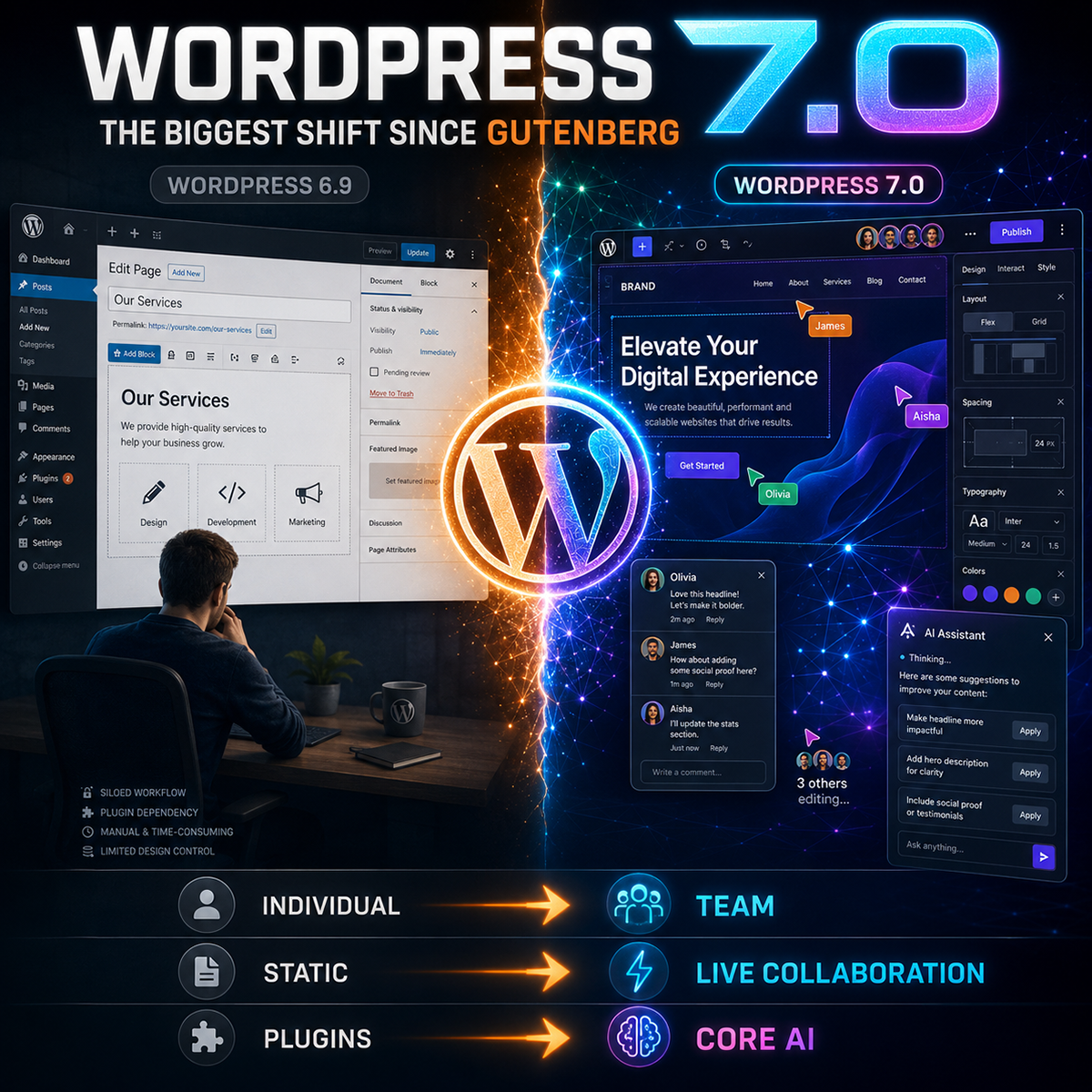
That means the platform is shifting from:
- Individual content creation → Team-based workflows
- Static publishing → Live, collaborative editing
- Plugin-dependent features → Core-native capabilities
In short: – WordPress is becoming more like Google Docs + Webflow + AI tools – inside one CMS
What WordPress 6.9 Already Did (The Foundation)
Before we talk about the leap, it’s important to understand WordPress 6.9.
Version 6.9 introduced early collaboration and workflow improvements, including:
- Block-level commenting (“Notes”)
- Asynchronous collaboration inside the editor
- Performance improvements
- Expanded block library to reduce plugin dependency
But here’s the key limitation: Collaboration existed—but it wasn’t live
WordPress 7.0: The Game-Changing Features
1. Real-Time Collaboration (Finally)
This is the headline feature.
WordPress 7.0 introduces true real-time editing, allowing multiple users to:
- Edit the same page simultaneously
- See live cursor positions
- Track changes instantly
- Avoid content overwrite conflicts
Why this matters:
- No more “who has the latest version?”
- No more switching between Google Docs and WordPress
- Editorial workflows become seamless
This alone changes how agencies, teams, and content creators operate.
2. Built-In AI Infrastructure (Not Just Plugins Anymore)
WordPress 7.0 introduces a standardized AI integration layer:
- AI provider packages (OpenAI, Google, Anthropic)
- Shared API for plugin developers
- Ability to switch providers without rebuilding features
This is critical.
WordPress isn’t just “adding AI” – it’s building an AI ecosystem inside core.
Expected capabilities (via plugins leveraging core APIs):
- AI content generation
- Image creation & optimization
- Personalization engines
- Automated workflows
WordPress becomes AI-ready by default
3. A Completely Evolved Site Editor (FSE 2.0)
Full Site Editing gets a major upgrade:
- Easier template management directly in the editor
- Improved reusable patterns (headers, footers, sections)
- More intuitive workflows for non-developers
:contentReference[oaicite:4]{index=4}
Translation:
You won’t need to jump between screens anymore.
Everything happens in one unified editing experience.
4. Admin UI & Workflow Overhaul
WordPress 7.0 modernizes the admin experience with:
- Cleaner UI/UX design
- Unified design system
- Better navigation and consistency
This addresses one of WordPress’ biggest long-term complaints: “It feels outdated compared to modern builders.”
5. Advanced Collaboration Tools (Beyond Editing)
Collaboration isn’t just typing together.
WordPress 7.0 expands into:
- Visual change tracking (in-editor revisions)
- Presence indicators (who’s working where)
- Improved communication tools inside the CMS
:contentReference[oaicite:6]{index=6}
This positions WordPress as a full content operations platform—not just a CMS.
6. Performance + Modern Architecture
WordPress 7.0 continues performance gains:
- Faster database queries
- Improved rendering efficiency
- Better caching strategies
:contentReference[oaicite:7]{index=7}
It also pushes modernization:
- Higher PHP requirements
- Cleaner architecture
- Better scalability for complex sites
7. Expanded Block System & Design Control
Expect:
- New core blocks (grids, tabs, navigation upgrades)
- Responsive design controls
- More visual styling without custom code
WordPress continues moving toward no-code / low-code site building
WordPress 6.9 vs 7.0: The Real Difference
| Feature | WordPress 6.9 | WordPress 7.0 |
|---|---|---|
| Collaboration | Comments & notes | Live real-time editing |
| AI | Infrastructure only | Usable AI ecosystem |
| Editing | Improved FSE | Unified editing experience |
| Workflow | Asynchronous | Simultaneous teamwork |
| UI | Incremental updates | Modernized admin system |
| Performance | Optimized | Architectural improvements |
Why This Is a “Drastic” Change
Let’s be clear:
WordPress 7.0 is not incremental—it’s directional.
It transforms WordPress from:
- A publishing tool → A collaboration platform
- A CMS → A content operating system
- A plugin-first ecosystem → A core-powered platform
What This Means for Businesses & Agencies
At The X Concept, here’s how we see it:
1. Agencies Must Rethink Workflow
- Client collaboration happens inside WordPress
- Fewer external tools required
2. AI Will Become Standard (Not Optional)
- Early adopters gain a massive advantage
- Content velocity increases dramatically
3. Development Becomes More Strategic
- Less time on basic builds
- More focus on customization, performance, and integrations
4. Hosting & Infrastructure Matters More
- Real-time features require better environments
- Outdated hosting will bottleneck performance
Should You Upgrade Immediately?
Short answer: Not blindly.
Recommended approach:
Reach Out to Us so we can
- Create a staging environment
- Test plugins & themes
- Evaluate collaboration needs
- Prepare hosting for higher requirements
WordPress 7.0 introduces real architectural changes, not just features.
Final Thoughts
WordPress 7.0 signals something bigger than a version change.
It’s the moment WordPress fully steps into:
- Collaboration
- AI integration
- Modern web application workflows
And for those paying attention – this is where competitive advantage is built.
About the Author
Charles Oreve
Owner, The X Concept
https://thexconcept.com
We help businesses leverage modern web technologies, AI integration, and high-performance digital strategy to stay ahead of the curve.